

If you are sixty-five or older, your federal tax shelter expands dramatically for the 2027 tax year. The IRS has raised baseline shields while preserving a massive temporary carveout.
Between annual inflation adjustments and recent legislative overhauls, qualifying seniors can shield up to tens of thousands of dollars from federal taxation. You will claim these expanded benefits on the returns you file in early 2028.
Behind these write-offs lies an intense Capitol Hill lobbying campaign fueled by millions in political donations. We tracked the money trail to see who funded this relief and what it means for your wallet.
Flashpoint: How Corporate PAC Cash Shaped Senior Tax Shelters
On November 5, 2026, the Internal Revenue Service released news release IR-2026-133, formalizing annual inflation adjustments under Revenue Procedure 2026-35. While administrative on its face, the announcement finalized a multi-year political struggle over senior wealth protection.
The adjustments expand baseline shields for every taxpayer, but older Americans receive preferential treatment. Lawmakers baked extra age-based write-offs directly into the tax code to appease an indispensable voting bloc.
The push escalated during debates over the One Big Beautiful Bill Act, also known as the Working Families Tax Cuts. That legislation layered an unprecedented bonus deduction on top of standard allowances.
Campaign finance records show that political action committees representing retirement communities, wealth managers, and senior lobbies distributed millions ahead of the vote. Lawmakers quickly answered with targeted relief.
The resulting framework delivers substantial write-offs for older filers. It also offers a case study in how targeted lobbying secures preferential tax treatment for organized demographics.
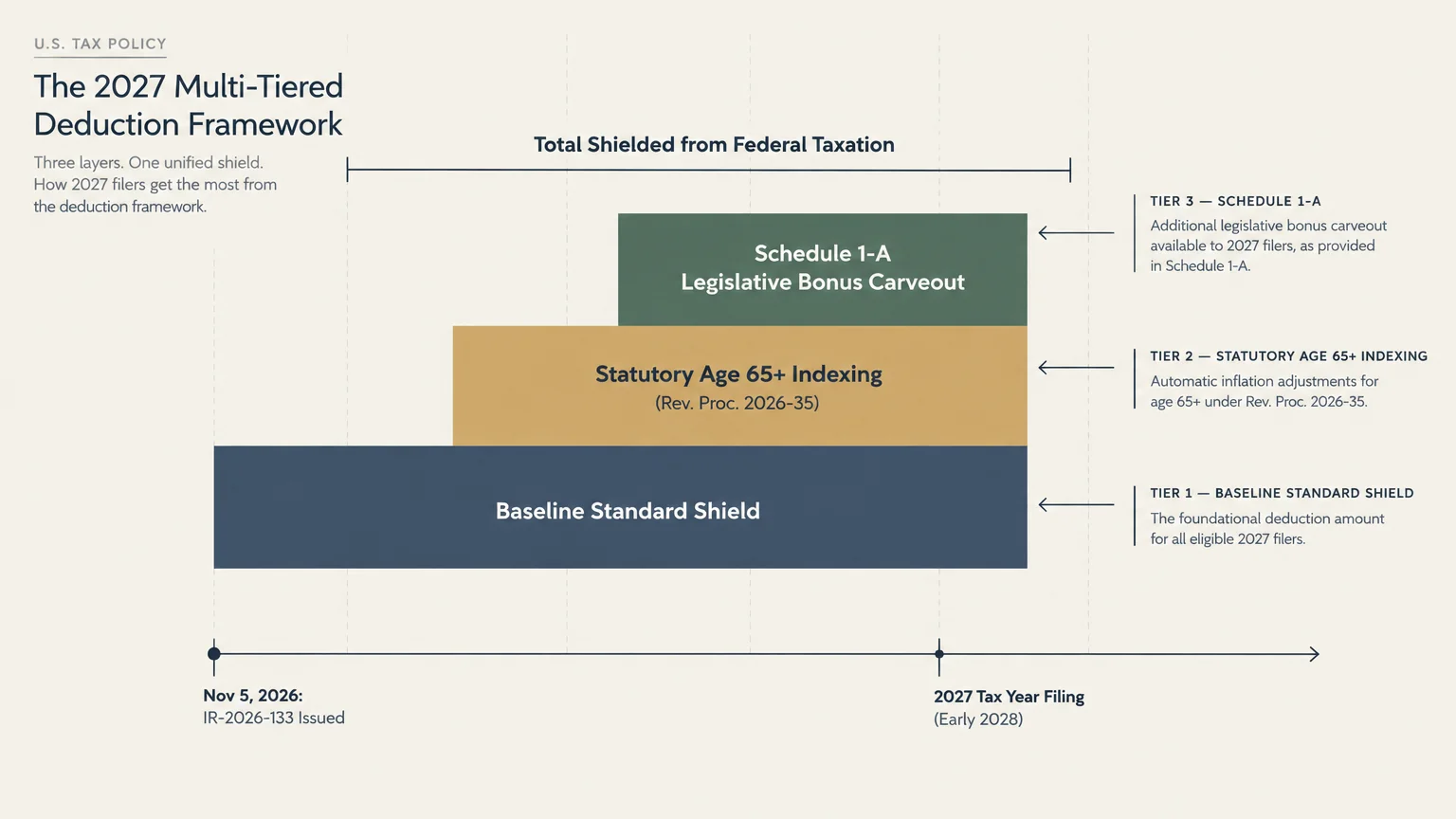
To grasp the scale of these adjustments, you must track both statutory indexing and legislative carveouts. The system delivers a multi-tiered deduction framework starting in 2027.
Source Map: Donors, PACs, and the Beneficiaries of Schedule 1-A
Tracing the political capital behind tax write-offs reveals a coordinated effort among major donor coalitions. Powerful organizations spent heavily to guarantee that older voters received sweeping federal exemptions.
Federal campaign disclosures cataloged by the Federal Election Commission reveal sharp spending spikes before committee markups. Political action committees funneled money straight to key tax-writing members.
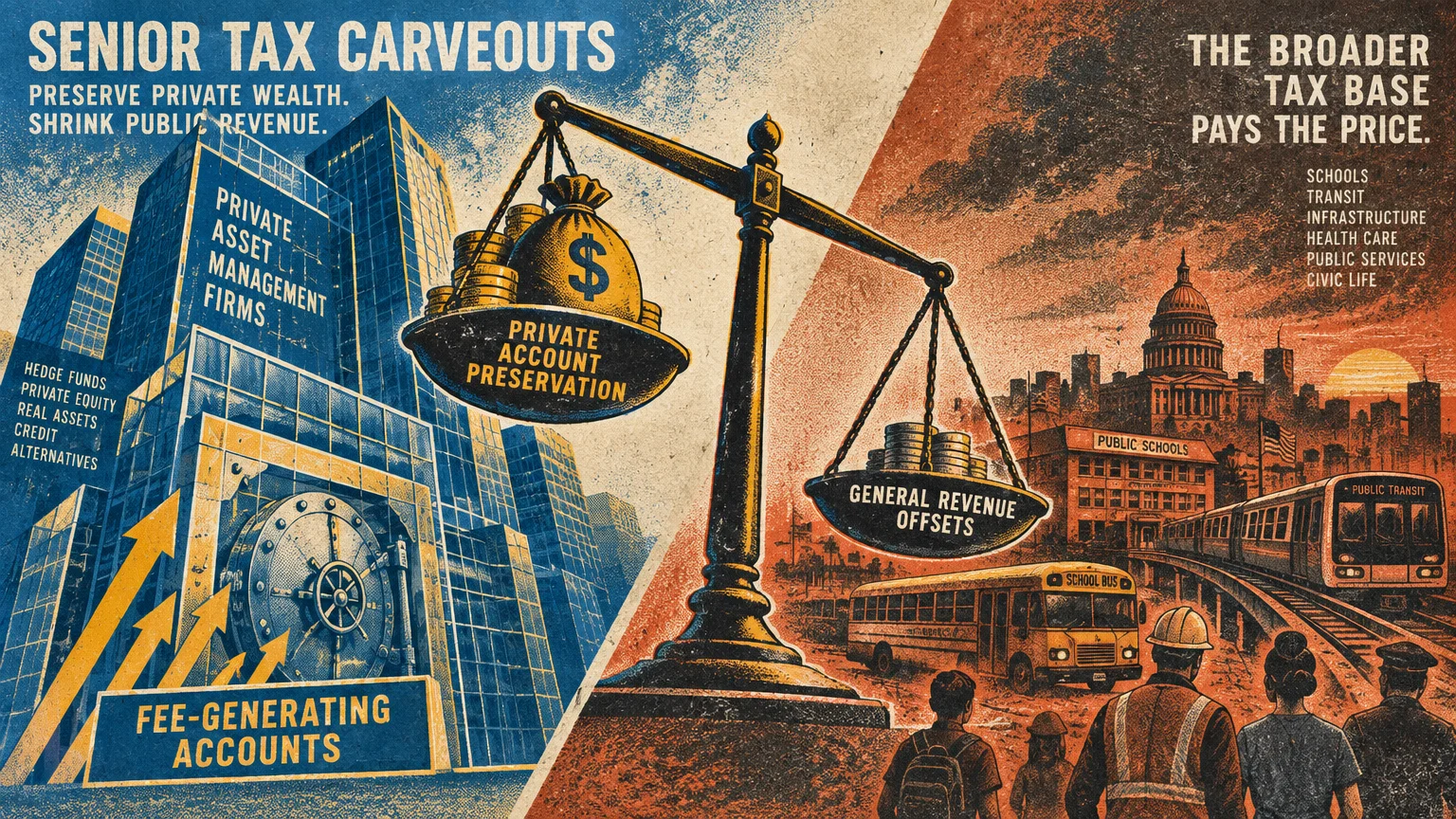
Financial service institutions and wealth management lobbies led the charge. These firms manage trillions in private retirement accounts, giving them an enormous stake in tax sheltering.
When clients face lower federal levies, assets remain parked in private fee-generating accounts longer. That reality drove intense corporate advocacy across Capitol Hill.
Data tracked by OpenSecrets shows that senior advocacy organizations and asset managers directed significant sums toward members of the House Ways and Means Committee. Beneficiaries sat on both sides of the political aisle.
Congressional leadership also took in major contributions through affiliated leadership PACs. In exchange, lawmakers inserted targeted write-offs into the legislative text.
The signature victory of this lobbying push was the senior bonus deduction. Lawmakers created this separate allowance specifically to insulate retirees from broader revenue-raising offsets.
Dark money non-profit groups registered under section 501(c)(4) ran parallel issue ads in pivotal congressional districts. These campaigns praised vulnerable lawmakers for protecting older citizens from aggressive tax enforcement.
The resulting legislation introduced Schedule 1-A, a new tax schedule designed specifically for older filers. The schedule separates senior write-offs from ordinary deductions, solidifying their protected status.
Influence Mechanisms: Translating Lobbying Retainers into Federal Code
Special interest money moves through well-established influence channels before hardening into statutory tax code. Lobbying firms deploy former congressional staff to draft legislative text that delivers lucrative carveouts.
Official filings in the Senate Lobbying Disclosure Act database show hundreds of registrations referencing senior tax equity and retirement security. K Street firms secured substantial retainers to shape these provisions.
Lobbyists framed senior deductions as essential economic relief for older citizens on fixed incomes. Behind closed doors, they negotiated phase-out ceilings that kept the write-offs open to affluent households.
The One Big Beautiful Bill Act capped income phase-outs at generous levels. The write-off targets single filers earning up to $75,000 and couples earning up to $150,000 before reductions begin.
Lawmakers chose a gentle 6% phase-out rate for income above those limits. This structure lets partial benefits flow to filers well into upper-middle-class income brackets.
The legislative strategy also relied on strategic expiration dates. Rather than making the $6,000 senior bonus permanent, Congress scheduled it to sunset after the 2028 tax year.
Expiring provisions create recurring legislative leverage. Lawmakers can tap senior lobbies and industry PACs for fresh donations every time a renewal deadline approaches.
This sunset mechanism keeps campaign coffers full while allowing politicians to pose as defenders of retirees. Meanwhile, taxpayers must navigate shifting federal rules to protect their savings.
The 2027 Math: What You Can Actually Shield from the IRS
To optimize your tax filing, you need to understand how the IRS stacks these deductions. The baseline deduction for tax year 2027 sets the foundation for your overall tax strategy.
Under Revenue Procedure 2026-35, the standard deduction for single filers and married individuals filing separately rises to $16,600. That marks a $500 increase over the 2026 rate.
For married couples filing jointly, the standard deduction increases by $1,000 to reach $33,200. Heads of household see their baseline deduction climb to $24,925.
If you are age 65 or older, you receive an extra age-based standard deduction. For unmarried filers, this extra allowance is $2,100, which reflects a $50 boost from 2026.
For married seniors, the extra deduction is $1,700 per qualifying spouse. If both you and your spouse are 65 or older, you claim an extra $3,400 together.
A single senior receives a total combined standard deduction of $18,700. A married couple with both spouses 65 or older claims a combined $36,600 without itemizing a single receipt.
You can also claim the $6,000 senior bonus deduction established by the One Big Beautiful Bill Act. If both you and your spouse are 65 or older, that bonus doubles to $12,000.
Unlike the standard deduction, this temporary $6,000 bonus is not indexed for inflation. It remains a flat amount through its scheduled expiration at the end of 2028.
You claim this bonus as a below-the-line deduction on Schedule 1-A. You can take it whether you claim the standard deduction or choose to itemize.
The bonus phases out at a 6% rate on modified adjusted gross income over $75,000 for single filers. For married couples filing jointly, the phase-out starts at $150,000.
When you combine all available allowances, the total tax shelter is massive. A single senior earning under $75,000 can shield up to $24,700 from federal income tax in 2027.
A qualifying married couple with both spouses age 65 or older can shield up to $48,600. That breaks down to $33,200 baseline, $3,400 age allowance, and $12,000 from Schedule 1-A.
You should review official administrative guidance directly through the Internal Revenue Service to verify your status. Proper documentation guarantees you capture every dollar the law allows.
Accountability Tracking: Sunset Provisions, Deficit Costs, and Ethics Scrutiny
The fiscal fallout from these expanded carveouts extends well beyond annual IRS announcements. Nonpartisan analysts warn that these multi-layered exemptions blow substantial holes in federal revenue projections.
Watchdog assessments published by the Tax Foundation highlight the long-term fiscal distortions created by targeted senior exemptions. Carveouts for specific age cohorts shift the tax burden onto younger, working-age earners.
Federal budget watchdogs calculate that exempting tens of billions in senior income accelerates federal deficits. Yet neither political party shows appetite for curbing benefits directed at older voters.
Government ethics watchdogs have scrutinized the timing of campaign donations surrounding the passage of the One Big Beautiful Bill Act. Several committee leaders received substantial PAC contributions days before markup sessions.
Lawmakers justified the generous $75,000 and $150,000 phase-out thresholds as middle-class relief. In practice, these thresholds let relatively affluent households shelter substantial non-wage income.
Because the $6,000 bonus is not indexed for inflation, its real value erodes slightly each year. Congressional committees rejected automatic inflation adjustments to limit the bill’s official ten-year budget score.
This scoring trick let lawmakers minimize the projected deficit impact on paper. In reality, they plan to push for permanent extensions before the 2028 sunset deadline arrives.
Watchdog organizations continue to flag these legislative maneuvers as classic budget gimmicks. They allow politicians to deliver massive tax cuts today while concealing the long-term fiscal pain.
Public Impact: The Financial Winners and Losers of the New Code
The practical consequences of the 2027 tax structure vary significantly based on your household income and filing status. Navigating the rules requires understanding where the tax code grants benefits and where it claws them back.
Middle-income retirees emerge as the clear financial winners under this expanded framework. If your modified adjusted gross income remains below the phase-out floors, you shield substantial income from federal rates.
For example, a retired couple with $45,000 in combined taxable income pays zero federal income tax. Their combined $48,600 deduction eliminates their entire regular liability.
This structure also provides tax shelter for seniors who continue working part-time. Wage income combines with retirement distributions without generating tax, provided total earnings stay below standard and bonus ceilings.
Working seniors must monitor their income carefully to avoid the phase-out range. Every $1,000 of income above $75,000 for single filers reduces the $6,000 bonus by $60.
Once a single senior’s income crosses $175,000, the Schedule 1-A bonus deduction disappears completely. However, they retain the full base standard deduction and the extra age-based deduction.
Younger workers carry the hidden costs of this system. They fund federal entitlement programs through payroll taxes while receiving no comparable age-based standard deductions.
Taxpayers who itemize deductions also gain an advantage from the new Schedule 1-A. Because the $6,000 bonus sits below the line, you can claim it alongside itemized medical expenses.
This hybrid treatment delivers substantial flexibility for older filers with significant healthcare bills. You do not have to choose between large medical deductions and the senior bonus write-off.
Frequently Asked Questions: Tracing Political Money in Tax Policy
How does coordinated spending work between candidate campaigns and senior advocacy PACs?
Federal election law bars candidates from coordinating strategy directly with independent expenditure-only committees. However, political operatives exploit extensive legal loopholes to bypass these restrictions.
PACs and campaigns frequently hire the same media vendors and research consultants. These common vendors share polling data and messaging strategies without triggering formal coordination investigations.
Candidate committees also post public b-roll footage and scheduling calendars on open websites. Super PACs then download these assets to produce targeted ads promoting the candidate’s tax policy stance.
Because no private communication occurs, the Federal Election Commission rarely penalizes these arrangements. This system lets campaigns outsource multi-million-dollar advocacy drives to unregulated corporate entities.
What limits exist on Super PAC donations directed toward tax legislation?
Super PACs face no statutory limits on the amount of cash they can raise from individuals, corporations, or unions. A single billionaire or corporate entity can donate unlimited millions to influence legislative debates.
These groups cannot donate money directly to political candidates or party committees. Instead, they run independent issue campaigns designed to reward or punish lawmakers based on their tax votes.
Traditional PACs, by contrast, face strict federal contribution caps per candidate per election cycle. To bypass these limits, corporate donors channel massive sums through multi-candidate Super PAC networks.
These entities spend heavily on digital and broadcast ads during key congressional tax markups. Their spending guarantees that committee members protect donor-favored tax write-offs.
Where are the primary disclosure gaps in lobbying reporting for federal tax bills?
The Lobbying Disclosure Act requires registered lobbyists to file quarterly reports detailing their income and legislative targets. However, these filings rarely specify the exact statutory clauses lobbyists seek to alter.
A disclosure form might list broad topics like internal revenue code reform or retirement security. It will not reveal that the lobbyist drafted the specific text behind the Schedule 1-A deduction.
Furthermore, grassroots lobbying campaigns face zero disclosure requirements under current federal statutes. Organizations can spend tens of millions mobilizing public pressure without revealing their underlying funding sources.
Strategic advisory firms also skirt disclosure laws by classifying their operatives as strategic consultants rather than lobbyists. This allows former lawmakers to orchestrate legislative campaigns without filing public reports.
What investigative tools can you use to track tax lobby spending?
You can track political money flows using several publicly accessible databases. The official website of the Federal Election Commission offers searchable records of individual and committee donations.
The Senate Office of Public Records and the House Legislative Resource Center maintain public lobbying disclosure databases. You can search these portals by corporation name, lobbyist, or bill number.
Nonpartisan research platforms aggregate these disparate public databases into accessible formats. These tools allow you to cross-reference campaign contributions with committee assignments and voting records.
You can also examine tax returns filed by 501(c)(4) advocacy organizations using the IRS non-profit database. These filings expose how dark money entities distribute funds to influence federal policy debates.
The Watchdog Watchlist: Critical Deadlines and Legislative Clashes
The 2027 tax changes mark the beginning of a larger legislative confrontation over federal tax exemptions. You must monitor several impending deadlines and oversight dates over the coming months.
The IRS will distribute draft 2027 forms, including the updated Schedule 1-A, during the second half of 2026. Reviewing these draft releases early gives you advance insight into documentation requirements.
The 2027 standard deduction rules officially take effect on January 1, 2027. You will apply these numbers to income earned throughout that calendar year.
You will file your actual 2027 tax return claiming these expanded amounts in early 2028. Make sure you organize your cost-of-living adjustments, pension payouts, and investment distributions ahead of time.
On Capitol Hill, watch quarterly lobbying filings from major senior advocacy groups and financial institutions. These records will reveal which organizations are funding the push to make the $6,000 bonus permanent.
The biggest legislative showdown will hit Congress in late 2028. The $6,000 senior bonus deduction expires on December 31, 2028, unless lawmakers pass an extension.
This impending sunset guarantees a fierce lobbying battle during the 2028 election cycle. Both parties will attempt to leverage the threat of higher senior taxes to extract campaign contributions.
We will track campaign finance filings, dark money ad buys, and committee markups as that deadline approaches. Understanding these political money trails helps you protect your retirement savings from shifting federal agendas.