

Senator Bernie Sanders posted on November 7, 2026, that expanding benefits by $2,400 a year will top his Senate agenda next year. Voters gave Democrats both chambers in the November 3 midterms, putting Sanders in line to chair a key Social Security subcommittee.
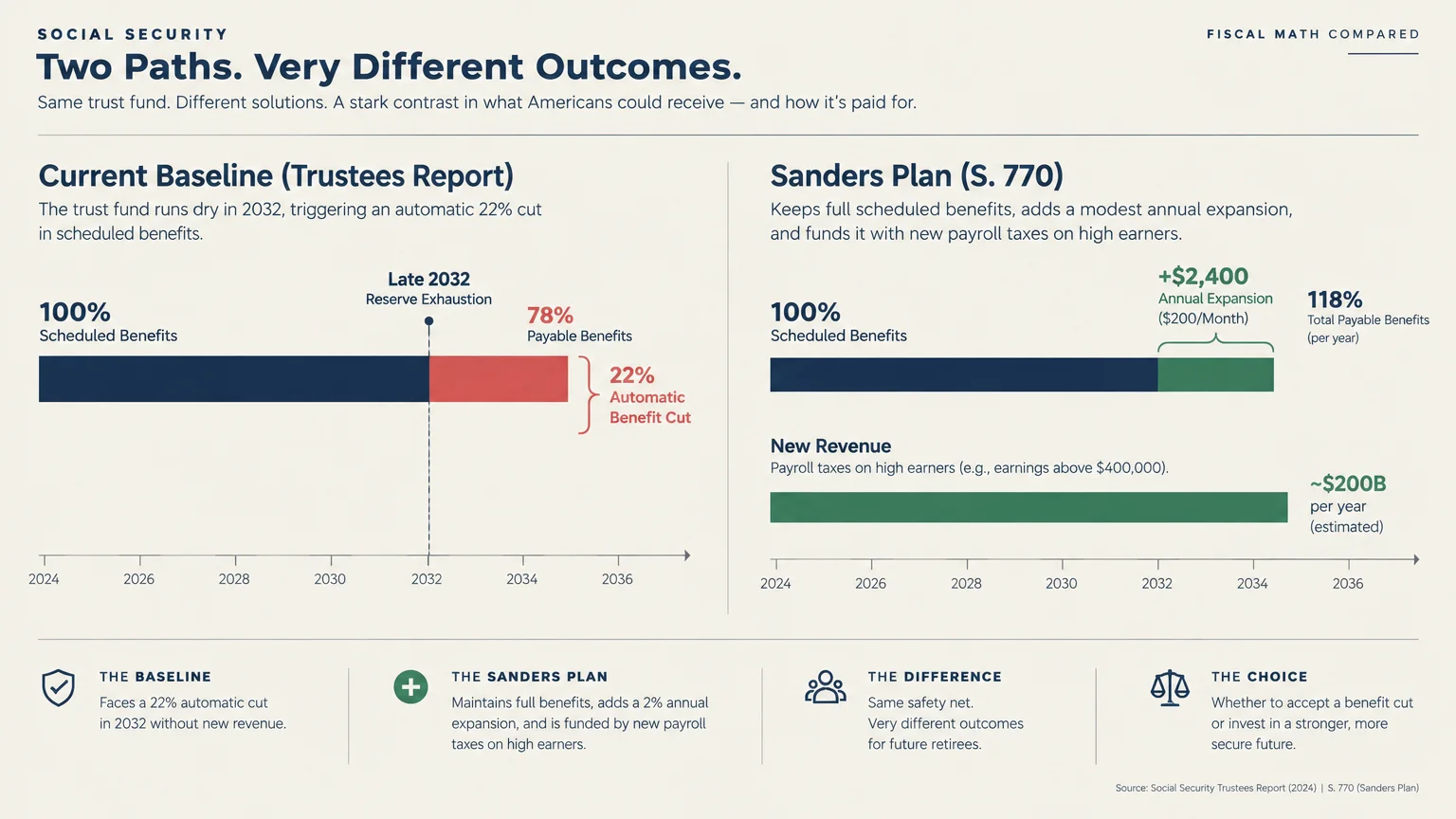
Meanwhile, the June 2026 Social Security Trustees Report projects the retirement trust fund will exhaust reserves in late 2032. Without congressional action, automatic payroll tax revenue will cover only 78% of scheduled benefits.
You need to know whether Sanders’ Social Security Expansion Act can stop those 22% cuts and fund higher checks. The numbers reveal major fiscal gaps alongside steep legislative hurdles on Capitol Hill.
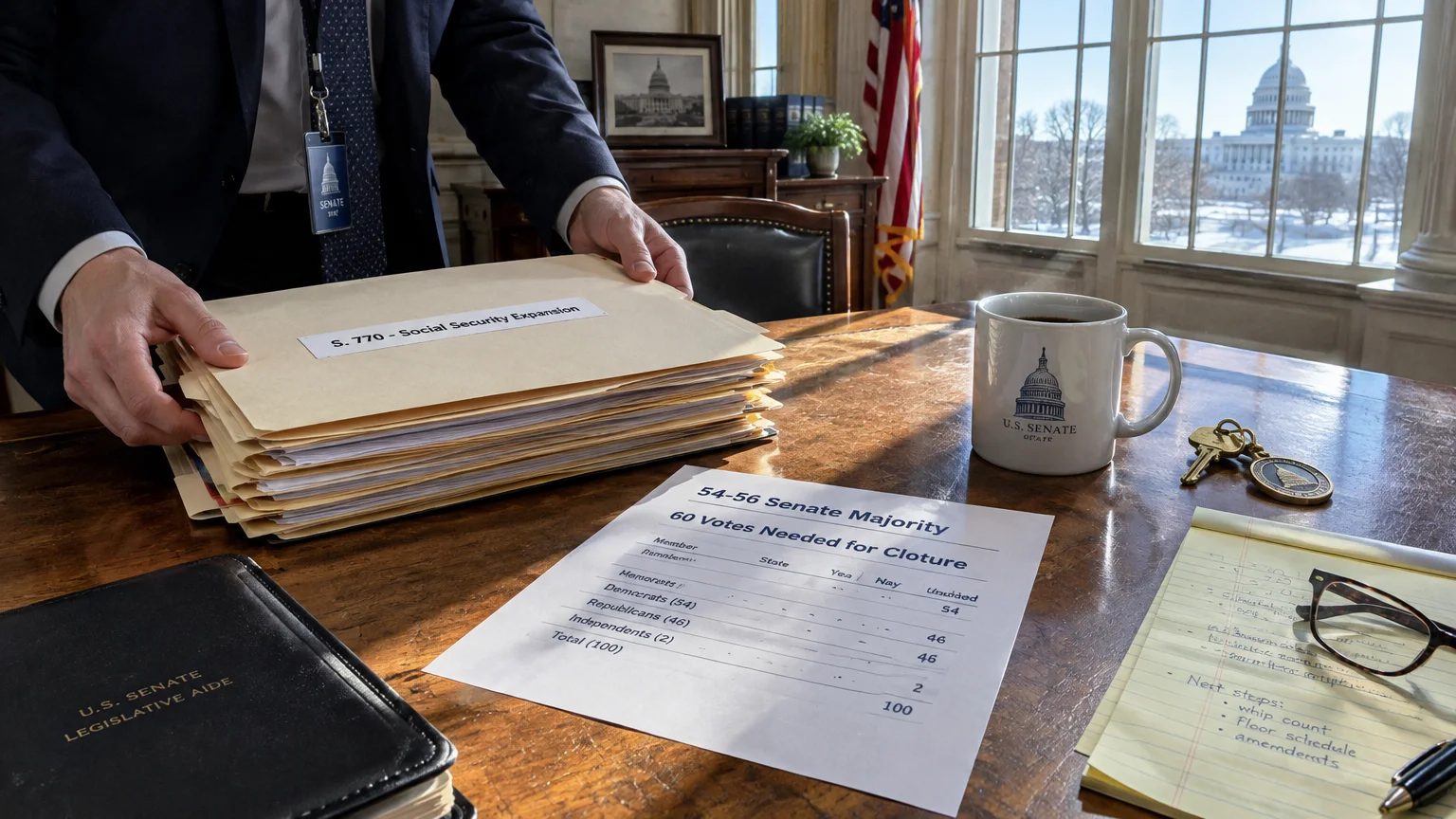
The Post-Midterm Power Map on Capitol Hill
Election results from November 3, 2026, reshaped the committee leadership controlling retirement policy in Washington. Reporting from the Associated Press, Jackson Lewis, and Dykema shows Democrats secured at least 228 House seats and 54 to 56 Senate seats.
That Senate majority includes independents who caucus with Democrats, giving the party committee gavels starting in January 2027. Newsweek and RFG News report Sanders is expected to replace Republican Senator Chuck Grassley of Iowa as chair of the Senate Finance Subcommittee on Social Security.
Holding that gavel lets Sanders schedule hearings and shape floor messaging ahead of the 2028 presidential race. However, a subcommittee chair cannot bypass Senate rules or erase opposition inside a divided government.
Sanders already has a legislative vehicle ready, though its current clock is ticking down. According to the NARFE Bill Tracker and ChamberLight, Sanders and Democratic Senator Elizabeth Warren of Massachusetts reintroduced the Social Security Expansion Act, Senate Bill 770 on Congress.gov, on February 27, 2025.
Only 10 Senate Democrats signed on as cosponsors of S. 770 in the 119th Congress. Representative Val Hoyle of Oregon introduced the House companion bill, H.R. 1700, drawing 41 Democratic cosponsors.
Both bills remain stalled in committee and will expire when the 119th Congress adjourns on January 3, 2027. Sanders and Hoyle must formally reintroduce the package once the 120th Congress convenes.
Even with unified Democratic control of Congress in 2027, passing Sanders’ bill faces two steep constitutional and procedural barriers. Under the Senate Byrd Rule, lawmakers cannot use simple-majority budget reconciliation to alter Social Security benefits or taxes.
Analyses from the Cato Institute, Dykema, and Scotia Wealth Management note any Social Security overhaul requires 60 Senate votes to overcome a filibuster. Projected Democratic seat totals of 54 to 56 leave Sanders several votes short of cloture.
Assuming some Senate Republicans crossed the aisle, the bill would still reach the desk of President Donald Trump. Overriding a presidential veto requires two-thirds majorities: 67 votes in the Senate and 290 votes in the House.
Competing proposals inside the Senate further complicate Sanders’ push for a sweeping expansion. AARP reported in November 2026 that Republican Senator Bernie Moreno of Ohio and Elizabeth Warren floated a separate bipartisan plan in June 2026.
Their concept eliminates the payroll tax cap without adding Sanders’ benefit increases or new investment taxes. Neither senator had introduced formal legislative text by November 2026, leaving the middle ground untested.
How the Social Security Expansion Act Works
To judge whether Sanders’ plan works for your household, you have to separate its benefit promises from its tax hikes. The proposal pairs broad benefit enhancements for retirees with steep new levies on top earners and business owners.
On the benefit side, the centerpiece is an across-the-board increase worth roughly $200 per month, or $2,400 per year. An earlier February 2023 Social Security Chief Actuary analysis of identical legislative text, cited by NARFE, explains how the formula changes.
S. 770 raises the first bend point in the Primary Insurance Amount formula by 22% and increases the first formula factor from 90% to 95%. Those technical tweaks boost monthly checks for both current beneficiaries and future retirees.
The bill also changes how your annual cost-of-living adjustment, or COLA, keeps pace with inflation. Currently, the Social Security Administration ties annual increases to the Consumer Price Index for Urban Wage Earners and Clerical Workers.
Sanders’ legislation switches that benchmark to the Consumer Price Index for the Elderly, which gives greater weight to healthcare and housing costs. The SSA Chief Actuary estimated in 2023 that this switch would add an average of 0.2 percentage points to annual COLAs.
Three targeted structural changes round out the benefit expansion in S. 770. First, the bill raises the special minimum benefit for lifelong low-wage workers to lift more retirees above poverty thresholds.
Second, summaries from NARFE and ChamberLight show the bill restores student benefits through age 22 for children of deceased or disabled workers. Under current law, those survivor and dependent benefits end at age 19.
Third, S. 770 merges the Old-Age and Survivors Insurance trust fund with the Disability Insurance trust fund. Combining them creates a single Social Security Trust Fund to pool incoming payroll tax revenue.
Paying for those expansions requires restructuring how the federal government taxes wages and capital above $250,000. Right now, workers and employers each pay a 6.2% Social Security payroll tax, totaling 12.4%, only up to an annual wage cap.
According to SSA announcements on October 14, 2026, that taxable maximum sits at $184,500 in 2026 and rises to $192,300 in 2027. An employee earning the maximum contributes $11,439 in 2026 and $11,922.60 in 2027.
Unlike Social Security, Medicare’s 1.45% payroll tax for workers and employers has no wage cap. High earners also pay an extra 0.9% Medicare surtax on wages above $200,000 for individuals or $250,000 for married couples filing jointly.
S. 770 leaves the existing wage cap intact up to $192,300 in 2027, then restarts the 12.4% Social Security payroll tax on all earned income above $250,000. That design creates a temporary untaxed gap—often called a donut hole—between $192,300 and $250,000 until wage growth pushes the lower cap up to meet $250,000.
Sanders’ office and RFG News state that households earning $250,000 or less would pay zero additional taxes under this structure. That shield covers more than 91% of American households.
However, payroll taxes on wages are only half of the bill’s revenue engine. Summaries from Financial Freedom Countdown and the Ohio School Employees Retirement System detail a major expansion of the Net Investment Income Tax.
Current law applies a 3.8% Net Investment Income Tax to investment earnings above $200,000 for single filers or $250,000 for joint filers. S. 770 raises that rate by 12.4 percentage points to 16.2% on income above $250,000.
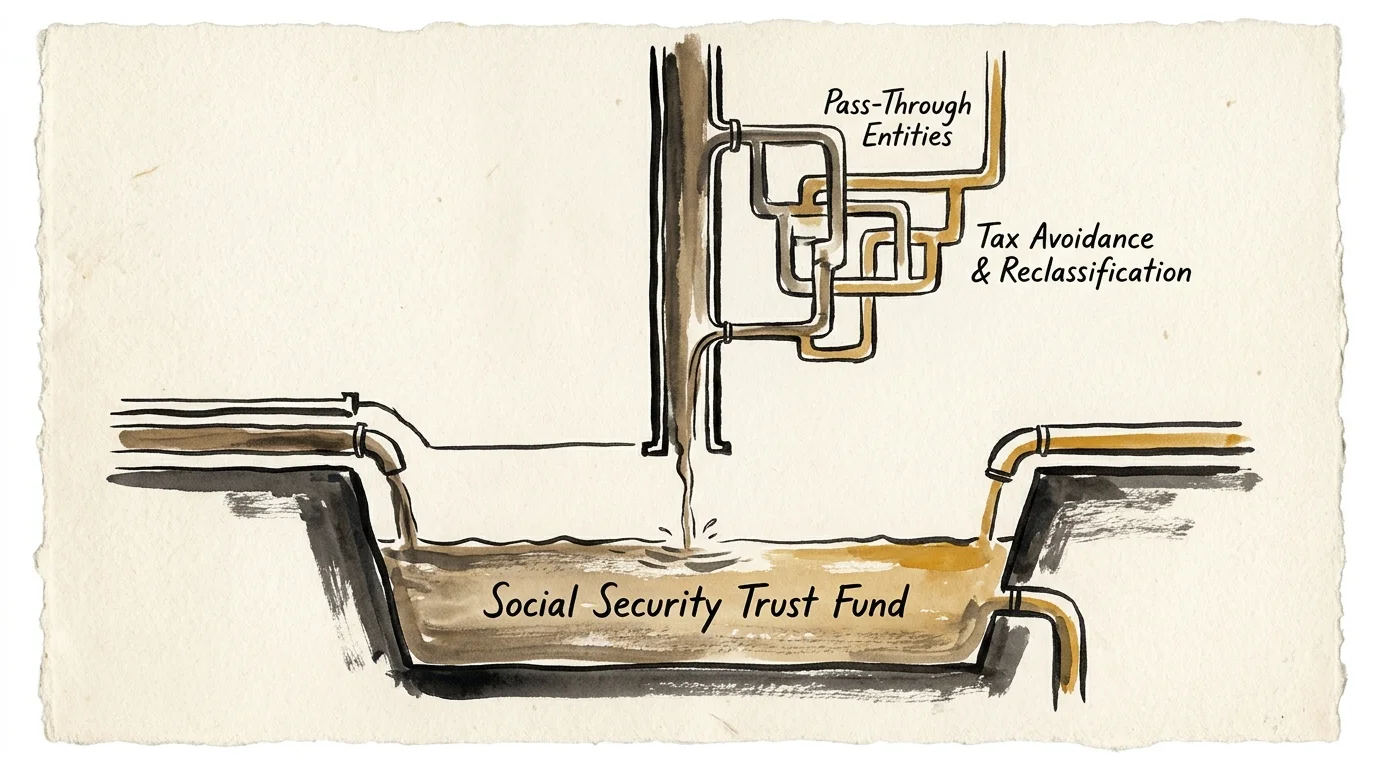
The bill also extends that 16.2% tax to active pass-through business income above $250,000 and dedicates the revenue directly to Social Security. That provision prevents high-earning business owners from converting salary into lightly taxed partnership distributions.
The 2026 Solvency Math vs. Sanders’ Solvency Claim
Whether Sanders’ plan actually stops benefit cuts depends entirely on which baseline numbers you examine. A sharp gap separates the 2023 actuarial score Sanders cites from the deteriorated financial reality reported in 2026.
On June 9, 2026, the Social Security Trustees Report delivered grim news for future retirees. The primary Old-Age and Survivors Insurance trust fund is now projected to run out of reserves in the fourth quarter of 2032.
That depletion date moved one quarter closer than the Trustees projected in 2025. Once reserves hit zero in late 2032, incoming payroll taxes will fund only 78% of scheduled benefits, forcing an automatic 22% across-the-board cut.
On a theoretically combined basis with the Disability Insurance fund, reserves last until the third quarter of 2034. At that point, ongoing revenue would pay 83% of benefits, requiring a 17% cut, while the Disability Insurance fund alone stays solvent through 2100.
Independent fiscal watchdogs warn the funding cliff could look even steeper. The Congressional Budget Office Social Security projections from February 2026 place retirement fund insolvency in fiscal year 2032, triggering an average 28% benefit cut in the years immediately following depletion.
Cash flow data from 2025 shows how fast reserves are draining today. Social Security collected $1.44 trillion in income during 2025 while paying out $1.60 trillion to 70 million recipients.
That $160 billion annual shortfall pulled combined reserves down to $2.56 trillion by the end of 2025. Over the next decade, the Trustees project cumulative cash deficits of $3.8 trillion.
Long-term solvency numbers deteriorated sharply in the 2026 report. The 75-year actuarial deficit widened roughly 16% in a single year, climbing from 3.82% to 4.42% of taxable payroll, or about 1.5% of gross domestic product.
In present-value terms, Social Security faces a $29.3 trillion funding gap over the next 75 years, up from $25.1 trillion in 2025. Three major forces drove that $4.2 trillion setback.
First, the Trustees lowered their long-term fertility assumption from 1.90 to 1.75 children per woman and reduced net immigration projections. Fewer future workers mean fewer payroll taxpayers supporting each retiree.
Second, recent laws enacted in 2025 reduced program revenue and accelerated outlays. Bipartisan Policy Center analysts and SSA Chief Actuary Karen Glenn point to revenue losses from the Social Security Fairness Act, signed in January 2025, and the One Big Beautiful Bill Act, signed on July 4, 2025, which cut income taxes collected on Social Security benefits.
Against this worsened 2026 baseline, Sanders still relies on an outdated solvency score. Neither the SSA Chief Actuary nor the Congressional Budget Office has scored the 2025 version of S. 770 under the 2026 Trustees assumptions.
Instead, Sanders cites a February 13, 2023 letter from the SSA Chief Actuary based on the much rosier 2022 Trustees Report. That 2023 score projected Sanders’ nine provisions would pay 100% of scheduled benefits for 75 years through 2096.
Even under that older baseline, the 2023 score showed the program would run cash surpluses only from 2024 through 2037. Annual cash deficits would return in 2038 and persist every year through 2096.
More importantly, Sanders’ frequent slogan of scrapping the cap on wages cannot fix the deficit by itself. Actuarial comparisons against the 2026 Trustees Report show that eliminating the payroll tax cap in 2026 without paying higher benefits closes only 2.55% of taxable payroll.
Against a 4.42% shortfall, taxing all wages covers just 58% of the 75-year deficit, leaving an unresolved 1.87% gap. Analysis from the Committee for a Responsible Federal Budget in April 2026 similarly finds that removing the cap alone closes about 65% of the shortfall and delays combined insolvency by 21 years to 2055.
The Cato Institute puts the standalone wage-cap fix even lower at 50.2% of the long-term cash-flow deficit. Consequently, Sanders’ entire promise to stop cuts and add $2,400 depends heavily on whether his 16.2% investment and business tax delivers massive, sustained revenue.
Constituency Check: Who Pays and Who Gains
Every policy choice in Washington carries uneven consequences for retirees, workers, and regional economies. Looking closely at household budgets shows who stands to gain from S. 770 and who faces steep tax bills.
Nearly 72 million Social Security beneficiaries—and 76 million Americans when including Supplemental Security Income recipients—depend on these monthly checks. SSA data from October 14, 2026, confirms beneficiaries will receive a 3.6% COLA starting in January 2027, up from 2.8% in 2026 and 2.5% in 2025.
That 2027 adjustment raises the average monthly retirement benefit by about $75, moving from $2,095 in 2026 to $2,170 in 2027. Workers claiming at full retirement age see maximum monthly benefits climb from $4,152 in 2026 to $4,188 in 2027.
For low- and middle-income seniors, those checks represent financial survival rather than supplemental cash. AARP data cited by Fortune in November 2026 shows Social Security provides the majority of total income for 43% of seniors.
If Congress misses the 2032 deadline, automatic cuts will hit every retirement bracket hard in 2033. Committee for a Responsible Federal Budget estimates show a 22% cut slices roughly $16,900 off annual benefits for a typical newly retired dual-income couple.
High-income newly retired couples would lose about $22,300 per year in 2033, while low-income dual-earner households would lose $10,200 annually. Adding $2,400 a year per recipient under S. 770 while halting that 22% reduction would protect tens of thousands of dollars in household income for retirees.
Workers earning under $250,000—roughly nine out of ten households—would receive those protections without paying higher payroll taxes. Younger families with children of disabled or deceased workers would also regain three years of student support through age 22.
By contrast, high-earning professionals, investors, and small-business owners structured as pass-through entities face dramatic marginal rate increases. Under current law, combined federal, state, and local tax burdens already climb steeply in high-tax jurisdictions.
Cato Institute calculations warn that layering a 12.4% payroll or investment tax above $250,000 pushes top combined marginal tax rates above 60% in states like California and New York. For self-employed consultants, physicians, and small-firm partners earning over $250,000, the full 12.4% tax hits directly unless split with an employer.
Despite fierce opposition from business groups to those marginal rates, polling shows surprisingly broad public support for lifting the wage cap. A 2025 survey of more than 4,000 Americans by the Bipartisan Policy Center, reported by CBS News in September 2026, revealed bipartisan consensus on taxing higher wages.
Exactly 65% of Democrats and 62% of Republicans supported lifting or removing the payroll tax cap. Even a majority of households earning more than $200,000 backed raising the threshold.
That polling suggests voters view higher payroll taxes on top salaries as fairer than cutting retiree checks or raising the retirement age. However, that poll tested lifting the wage cap, not Sanders’ steep 16.2% tax on capital gains and pass-through business profits.
Accountability Lens: Scoring, Tax Avoidance, and Revenue Losses
Political debates over Social Security frequently rely on selective numbers from both parties. You deserve an unvarnished look at how progressive solvency claims and conservative economic warnings hold up under watchdog scrutiny.
Progressives risk misleading voters when they cite the February 2023 Chief Actuary letter as proof that S. 770 fully secures Social Security today. Because the 2026 Trustees Report added $4.2 trillion to the 75-year present-value shortfall, a 2023 score built on 2022 data no longer reflects reality.
Until Sanders requests and publishes an updated 2026 baseline score from the SSA Chief Actuary or CBO, nobody can confirm whether S. 770 keeps the combined trust fund solvent through the century. Claiming full 75-year solvency without updated math ignores four years of lower fertility assumptions and 2025 tax legislation.
Fiscal conservatives raise equally pointed concerns about how taxpayers respond when marginal rates cross 60%. A 2023 Heritage Foundation critique estimated S. 770 imposes $33.8 trillion in total tax increases over time.
More recently, dynamic economic modeling highlights the risk of revenue leakage when tax rates spike abruptly. In August 2026, the National Taxpayers Union cited Tax Foundation dynamic modeling of the Warren-Moreno cap-elimination concept.
Static scoring projected that eliminating the payroll tax cap would raise $3.2 trillion over 10 years. Dynamic modeling—which accounts for slower economic growth and earners shifting compensation into untaxed forms—cut projected 10-year revenue roughly in half to $1.5 trillion.
While S. 770 tries to block compensation shifting by taxing investment and pass-through income at 16.2%, high marginal rates still discourage work, investment, and capital realization. Investors facing a 16.2% surtax on capital gains may simply delay selling assets, shrinking the cash flowing into Social Security during the critical 2030s.
Meanwhile, Congress has undermined its own credibility by passing laws that drained Social Security reserves without paying for them. Both the Social Security Fairness Act and the One Big Beautiful Bill Act enjoyed significant support in 2025, yet both accelerated the 2032 insolvency deadline.
Asking taxpayers to swallow massive tax hikes or benefit cuts tomorrow rings hollow when lawmakers repeatedly approve unfunded giveaways today. Real accountability in 2027 requires independent scoring of every proposal before committee votes occur.
Frequently Asked Questions About Timeline and Outcomes
Could S. 770 pass in the 2026 lame-duck session or early 2027?
No, the bill has virtually zero chance of passing during the remaining weeks of the 119th Congress, which adjourns on January 3, 2027. Once the 120th Congress convenes in January 2027, Sanders must reintroduce the legislation from scratch.
Even with Democrats controlling both chambers, S. 770 cannot pass through simple-majority budget reconciliation under the Senate Byrd Rule. Passing it requires 60 Senate votes plus enough bipartisan support—67 senators and 290 House members—to override a likely veto from President Trump.
When do automatic Social Security cuts take effect without a deal?
The June 2026 Trustees Report places depletion of the Old-Age and Survivors Insurance trust fund in the fourth quarter of 2032. Unless Congress acts before late 2032, incoming taxes will trigger an automatic 22% benefit reduction across retirement and survivor checks.
If Congress passes a temporary stopgap merging the retirement and disability trust funds, combined reserves stretch until the third quarter of 2034, resulting in a 17% cut. However, the Congressional Budget Office’s February 2026 baseline warns depletion in fiscal year 2032 could trigger an average 28% cut.
How does today’s funding gap compare to the 1983 Social Security overhaul?
Demographic and wage trends make today’s shortfall structurally harder to solve than the 1983 crisis. Bipartisan Policy Center data shows the ratio of covered workers to beneficiaries fell from more than 5-to-1 in 1960 to 2.9-to-1 in 2026, heading toward 2.2-to-1 by the 2070s.
At the same time, rapid wage growth at the very top of the income distribution eroded the payroll tax base. In 1983, Social Security payroll taxes covered 90% of all U.S. covered wages, whereas today’s cap captures only 83%.
What happens if Congress only removes the payroll tax cap without raising benefits?
Removing the wage cap without expanding benefits closes a large share of the deficit but leaves the job unfinished. Research from the Committee for a Responsible Federal Budget estimates eliminating the cap alone closes about 65% of the 75-year shortfall and delays combined insolvency until 2055.
By contrast, Cato Institute modeling puts the gap closed at 50.2%, and SSA Chief Actuary comparisons against the 2026 report show it closes 58% of the shortfall. Any cap-only compromise like the Warren-Moreno framework would still require further tax tweaks, benefit adjustments, or retirement-age changes to guarantee full 75-year solvency.
What to Watch Next and How to Prepare Your Finances
Over the first 100 days of 2027, watch three concrete milestones in Washington to gauge whether Social Security talks turn serious. First, track the formal appointment of Sanders to chair the Senate Finance Subcommittee on Social Security and his initial hearing schedule.
Second, demand to see whether Sanders secures a fresh 2026-baseline score from the SSA Chief Actuary or Congressional Budget Office when he reintroduces the Social Security Expansion Act. Without updated math, S. 770 functions primarily as an opening bargaining position rather than a verified solvency fix.
Third, watch whether Elizabeth Warren and Bernie Moreno introduce actual legislative text for their cap-only proposal. A bipartisan compromise that focuses strictly on stopping the 2032 cuts—without adding $2,400 benefit hikes—holds a much higher chance of reaching 60 Senate votes before 2032.
For your own household finances, do not wait for Congress to break a multi-decade stalemate before adjusting your retirement plan. Log in to your official Social Security account this month to verify your earnings record and projected monthly benefit at full retirement age.
If you plan to retire during the 2030s or rely heavily on Social Security, stress-test your budget against a temporary 22% benefit reduction starting in 2033. Building extra cushion into personal retirement accounts ensures your monthly living expenses stay covered even if lawmakers wait until the eleventh hour to act.
If your household earns or realizes capital gains above $250,000, monitor committee markup sessions closely throughout 2027. While S. 770 faces near-impossible veto math in the 120th Congress, bipartisan support for lifting the payroll tax cap means higher-income taxpayers remain the top target when a final solvency deal eventually arrives.