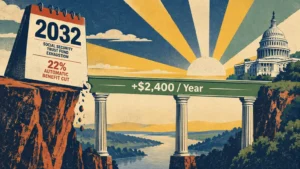

Federal trustees now project Social Security’s primary retirement fund will run dry in late 2032, triggering an automatic 22 percent benefit cut unless Congress acts. Critics blame President Donald Trump’s tax and immigration policies for pulling that deadline closer.
Administration officials reject that diagnosis and insist your earned benefits remain secure for decades. For workers and retirees alike, the clash between campaign promises and actuarial math now carries immediate financial stakes.
Understanding what shifted in the 2026 Social Security Trustees Report—and why both parties dispute the cause—helps you prepare your retirement budget before lawmakers face a high-stakes fiscal cliff.
The 2026 Insolvency Warning and the Clash Over Credit
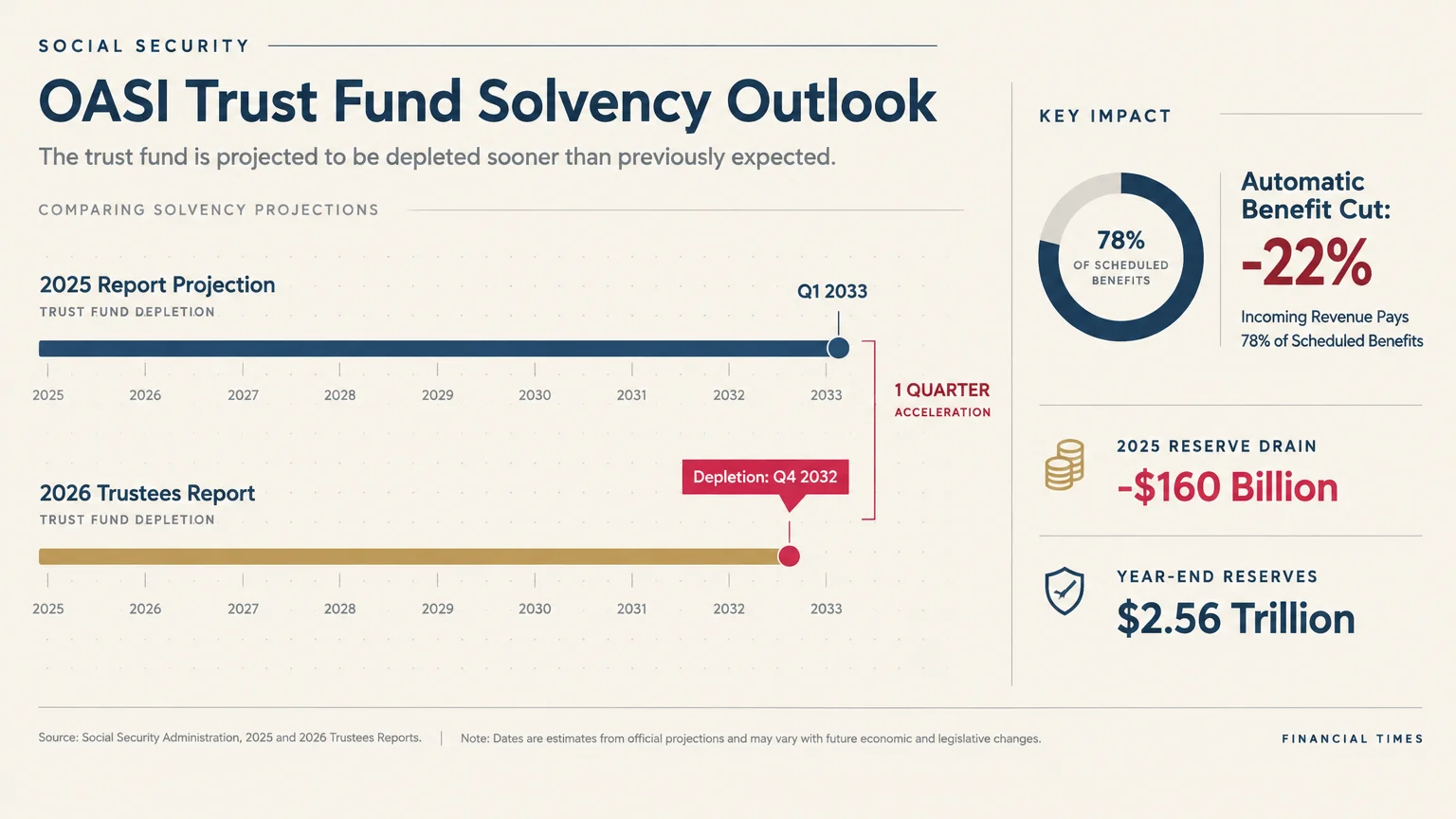
On June 9, 2026, the Social Security Board of Trustees delivered an unwelcome milestone for tens of millions of Americans. Their 2026 Trustees Report moved the projected depletion date for the Old-Age and Survivors Insurance (OASI) trust fund into the fourth quarter of 2032.
That timeline sits one quarter earlier than the first-quarter 2033 projection published just one year earlier. Under current federal law, reserve depletion leaves incoming tax revenue able to pay only 78 percent of scheduled retirement and survivor benefits.
Without congressional intervention, beneficiaries would face an automatic 22 percent across-the-board reduction in late 2032. Meanwhile, the separate Disability Insurance (DI) trust fund remains solvent across the entire 75-year projection window through 2100.
Even if Congress passed legislation merging both funds, the combined reserves would still run out in the third quarter of 2034. That temporary bridge would cover 83 percent of scheduled benefits at first—a 17 percent cut—before dropping to 65 percent by 2100.
Cash-flow figures from calendar year 2025 illustrate the relentless pressure squeezing the system. Social Security collected $1.44 trillion in total income while paying out $1.60 trillion to roughly 70 million beneficiaries, draining reserves by $160 billion down to $2.56 trillion.
Long-term red ink deepened alongside the shrinking reserve cushion. The Trustees raised their 75-year actuarial deficit estimate from 3.82 percent of taxable payroll in 2025 to 4.42 percent in 2026, representing an unfunded obligation between $29.3 trillion and $30 trillion.
Independent fiscal scorekeepers paint an even sharper warning for your retirement planning. In September 2026, the Congressional Budget Office (CBO) projected OASI exhaustion in fiscal year or mid-2032, triggering a 26 percent initial cut that widens to 40 percent by 2100.
Under CBO’s combined-fund scenario, reserves deplete in 2033 with a 23 percent initial reduction. CBO calculates the 75-year shortfall at 4.6 percent of taxable payroll, or 1.6 percent of gross domestic product.
Against those numbers, President Trump has repeatedly stood by his core campaign commitment. During his February 24, 2026 State of the Union address, he pledged to “always protect Social Security and Medicare” while touting his broader tax agenda.
The Power Map Steering Social Security’s Future
Control over Social Security’s trajectory splits across executive branch loyalists, nonpartisan scorekeepers, and congressional negotiators eyeing upcoming election cycles. Understanding who drives each lever helps you separate campaign messaging from legislative reality.
Inside the administration, Treasury Secretary and Managing Trustee Scott Bessent and Social Security Administration (SSA) Commissioner Frank J. Bisignano anchor the public defense. Both officials reject claims that White House policies weakened the program’s foundation.
In June and October 2026 remarks, Bessent pointed to tax relief enacted under Trump’s signature domestic law for “over 35 million seniors.” Bisignano asserted that Social Security “will be around for another 90 years” despite the Trustees’ timeline.
Bisignano framed operational tightening as the administration’s “first solution” to preserve solvency. He emphasized eliminating “waste, fraud, and abuse,” fixing beneficiary records, and cutting customer call wait times across agency field offices.
Outside the political appointees, nonpartisan analysts inside federal agencies hold the mathematical ledger. SSA Chief Actuary Karen P. Glenn and CBO budget analysts produce the statutory scorecards that lawmakers cannot easily wave away.
When legislation alters tax revenues or demographic inflows, those scorekeepers recalculate the exact quarter reserves hit zero. Their letters and annual reports regularly arm congressional critics with concrete fiscal ammunition.
On Capitol Hill, Democratic lawmakers including Sens. Ron Wyden and Elizabeth Warren and Rep. Gabe Vasquez lead the challenge against White House claims. They accuse the administration of masking long-term revenue losses behind misleading tax relief headlines.
Bipartisan fiscal watchdogs sit between the two parties and challenge spin from either side. Groups such as the Committee for a Responsible Federal Budget (CRFB), the Bipartisan Policy Center, and the Tax Policy Center track every legislative change against the 2032 deadline.
At the same time, electoral math binds both Republicans and Democrats from taking aggressive corrective steps. Neither party wants to champion higher payroll taxes or higher retirement ages ahead of federal elections, leaving the trust fund drifting closer to automatic cuts.
Policy Review: Inside the One Big Beautiful Bill Act and Immigration Shifts
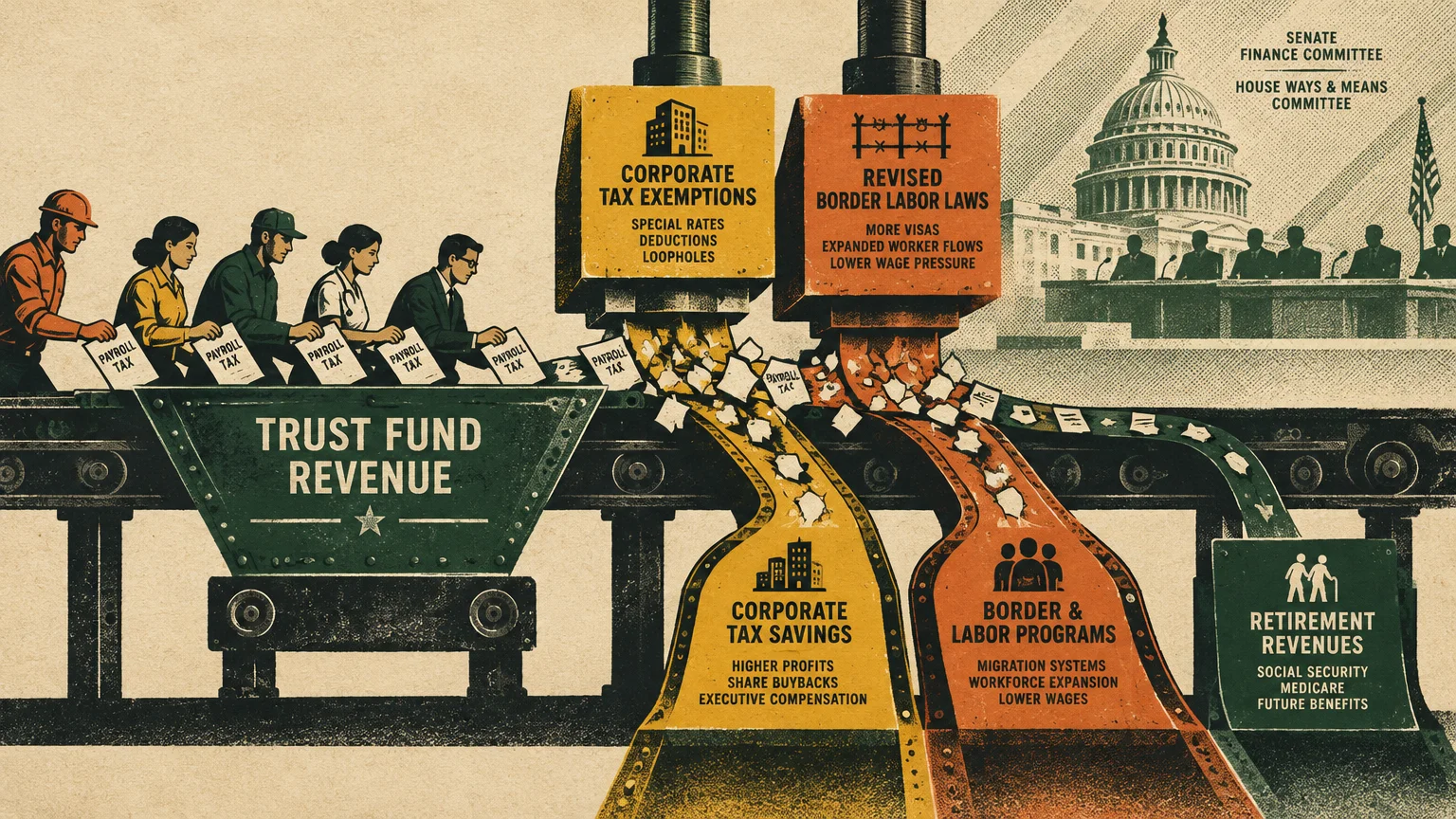
To see why critics argue Trump’s policies accelerated insolvency, you have to examine the specific statutory changes enacted during his second term. The central legislative flashpoint is the One Big Beautiful Bill Act (OBBBA), signed into law on July 4, 2025.
Why the 2025 Tax Law Did Not Repeal Benefit Taxes
Throughout the 2024 presidential campaign, Trump promised to eliminate federal income taxes on Social Security benefits. That pledge resonated strongly with middle-income retirees frustrated by paying federal tax on benefits funded by decades of payroll deductions.
However, Public Law 119-21—the enacted version of OBBBA—did not repeal federal income taxes on Social Security benefits. Existing statutory income thresholds remain intact on the books today.
Under current law, single filers with combined income above $25,000 and joint filers above $32,000 can owe taxes on up to 50 percent of their benefits. Above $34,000 for individuals and $44,000 for couples, up to 85 percent becomes taxable.
Roughly 50 percent of senior households cross those thresholds today because Congress never indexed them to inflation. CBO estimates those benefit income taxes generate $120 billion in 2026—equal to 7.1 percent of total benefits—and flow directly into the Social Security and Medicare trust funds.
Instead of repealing those thresholds outright, Section 70103 of OBBBA created a temporary workaround for older taxpayers. From tax years 2025 through 2028, taxpayers age 65 and older receive an additional $6,000 deduction per qualifying individual, or $12,000 for qualifying married couples filing jointly.
According to the Internal Revenue Service (IRS), both standard-deduction filers and itemizers can claim this senior bonus. Joint Committee on Taxation breakdowns show the deduction phases out at a 6 percent rate above $75,000 in modified adjusted gross income for single filers and $150,000 for joint filers.
Once modified adjusted gross income hits $175,000 for individuals or $250,000 for couples, the deduction drops to zero. Because the measure reduces seniors’ overall taxable income, it indirectly lowers the share of Social Security benefits subject to federal tax.
Actuarial Math, Immigration Cuts, and Bipartisan Spending
That indirect revenue drop carries a direct cost for the trust funds. In an August 5, 2025 letter to Sen. Ron Wyden, SSA Chief Actuary Karen P. Glenn quantified the exact fiscal damage from OBBBA.
Glenn estimated that reduced income tax revenue on benefits adds $168.6 billion in net OASDI program costs between 2025 and 2034. Her analysis showed the law widens the 75-year actuarial deficit by 0.16 percent of taxable payroll and pulls OASI depletion forward by one full quarter, from Q1 2033 to Q4 2032.
Even with that acceleration, the realized impact came in milder than earlier campaign warnings. In October 2024, CRFB projected that Trump’s full campaign platform—including total benefit-tax repeal, eliminating taxes on tips and overtime, universal tariffs, and mass deportations—could push combined insolvency to 2031 with a 33 percent benefit cut.
Because Congress settled on a temporary four-year senior deduction instead of permanent repeal, the immediate trust fund hit remained smaller. Still, tax rules represent only half of the policy shift reflected in the 2026 Trustees Report.
In February 2026, the Trustees updated their core demographic and immigration assumptions ahead of the annual report. They cut the ultimate fertility rate from 1.90 to 1.75 children per woman and sharply lowered projected net immigration.
Specifically, the Trustees reduced assumed temporary or unlawfully present entrants for 2022 through 2025 and lowered ultimate post-2035 annual entrant assumptions from 1.35 million to 1.20 million while raising emigration assumptions. Analysts at PBS News, the Bipartisan Policy Center, and the Progressive Policy Institute tie both OBBBA and Trump’s restrictive immigration policies to smaller future payroll tax inflows.
Balanced scrutiny also shows that Democratic-backed legislation added pressure right before Trump returned to office. On January 5, 2025, President Joe Biden signed the bipartisan Social Security Fairness Act, repealing the Windfall Elimination Provision (WEP) and Government Pension Offset (GPO).
By July 2025, SSA had issued more than 3.1 million retroactive or adjusted payments to public-sector retirees. CBO pegged the law’s 10-year cost at roughly $196 billion, while Brookings noted it expanded the 75-year deficit by 0.14 percent of taxable payroll in the 2025 baseline.
Crucially, lower tax receipts from OBBBA also spill over into federal healthcare solvency. The 2026 Trustees Report moved Medicare’s Hospital Insurance (HI) depletion date up one quarter to Q2 2033, while CBO pulled its HI exhaustion projection forward by 12 years—from 2052 to 2040—citing reduced benefit-tax revenue.
Constituency Check: What the Numbers Mean for Your Household
Macroeconomic trust fund projections often feel abstract until you translate them into monthly household budgets. Recent benefit adjustments and projected cliff scenarios reveal starkly different realities across age groups and income brackets.
In the near term, inflation adjustments continue pushing nominal monthly checks higher. On October 14, 2026, SSA announced a 3.6 percent cost-of-living adjustment (COLA) starting in January 2027, rising from the 2.8 percent bump delivered in 2026.
That 2027 COLA lifts the average monthly retired-worker check by $75, taking it from $2,095 to $2,170. Roughly 76 million Americans receive that increase, covering nearly 72 million Social Security beneficiaries and 7.3 million Supplemental Security Income recipients with some overlap.
Meanwhile, active workers and employers continue funding those payments through a 12.4 percent statutory payroll tax—split 6.2 percent each. The maximum earnings cap subject to that tax rises from $184,500 in 2026 to $192,300 in 2027, while full retirement age remains 67 for anyone born in 1960 or later.
Those steady paycheck deductions buy less long-term certainty if the 2032 insolvency cliff hits unresolved. CRFB estimates from 2026 show how severely a 22 percent benefit cut would squeeze newly retired households across income tiers.
For a typical newly retired dual-income couple, a 22 percent reduction slashes annual combined benefits by roughly $16,900. A high-income dual-earner couple would lose about $22,300 per year, while a low-income dual-earner couple would lose roughly $10,200 annually.
While critics highlight those future losses, the White House points to immediate tax savings under Section 70103. Yet Tax Policy Center estimates indicate fewer than half of American seniors actually benefit from the new $6,000 deduction.
Low-income retirees who rely almost entirely on Social Security already owe zero federal income tax under standard rules, so the deduction puts nothing extra in their pockets. Retirees younger than 65—such as early filers at age 62 or disability beneficiaries—also fall outside the age cutoff.
High-income retirees earning above $175,000 individually or $250,000 jointly phase out completely. As a result, the tax break concentrates among middle- and upper-middle-income seniors age 65 and older who hold pensions, retirement accounts, or part-time earnings.
Beneath every policy debate sits an unmistakable demographic shift reshaping the American workforce. Independent economists and the Bipartisan Policy Center emphasize that an aging population drives the core shortfall more than any single bill.
In 1960, more than five covered workers paid payroll taxes for every single Social Security beneficiary. Today, that ratio stands at 2.9 workers per beneficiary and is projected to fall to 2.2-to-1 by the 2070s.
At the same time, rising wage inequality has narrowed the tax base itself. Because earnings above the annual cap escape payroll taxation, the share of covered national wages subject to Social Security tax fell from 90 percent in 1983 to 83 percent today.
Accountability Lens: Messaging Disputes and Agency Workforce Cuts
Beyond trust fund math, watchdog scrutiny has focused sharply on how the administration communicates policy changes and manages SSA’s internal workforce. Accuracy in official agency messaging matters because millions of retirees make tax and claiming choices based on federal notices.
In July 2025 and again in July 2026, SSA sent mass emails to beneficiaries describing the impact of OBBBA. Those messages claimed the law eliminated taxes on Social Security benefits or delivered “over 35 million American seniors” an average of $7,500 in tax relief.
Independent tax advisors and congressional Democrats—including Sens. Warren and Wyden alongside Rep. Vasquez—condemned those emails as misleading. Because statutory thresholds taxing up to 85 percent of benefits never left the tax code, retirees who misread the notice risk underwithholding taxes and facing unexpected IRS bills.
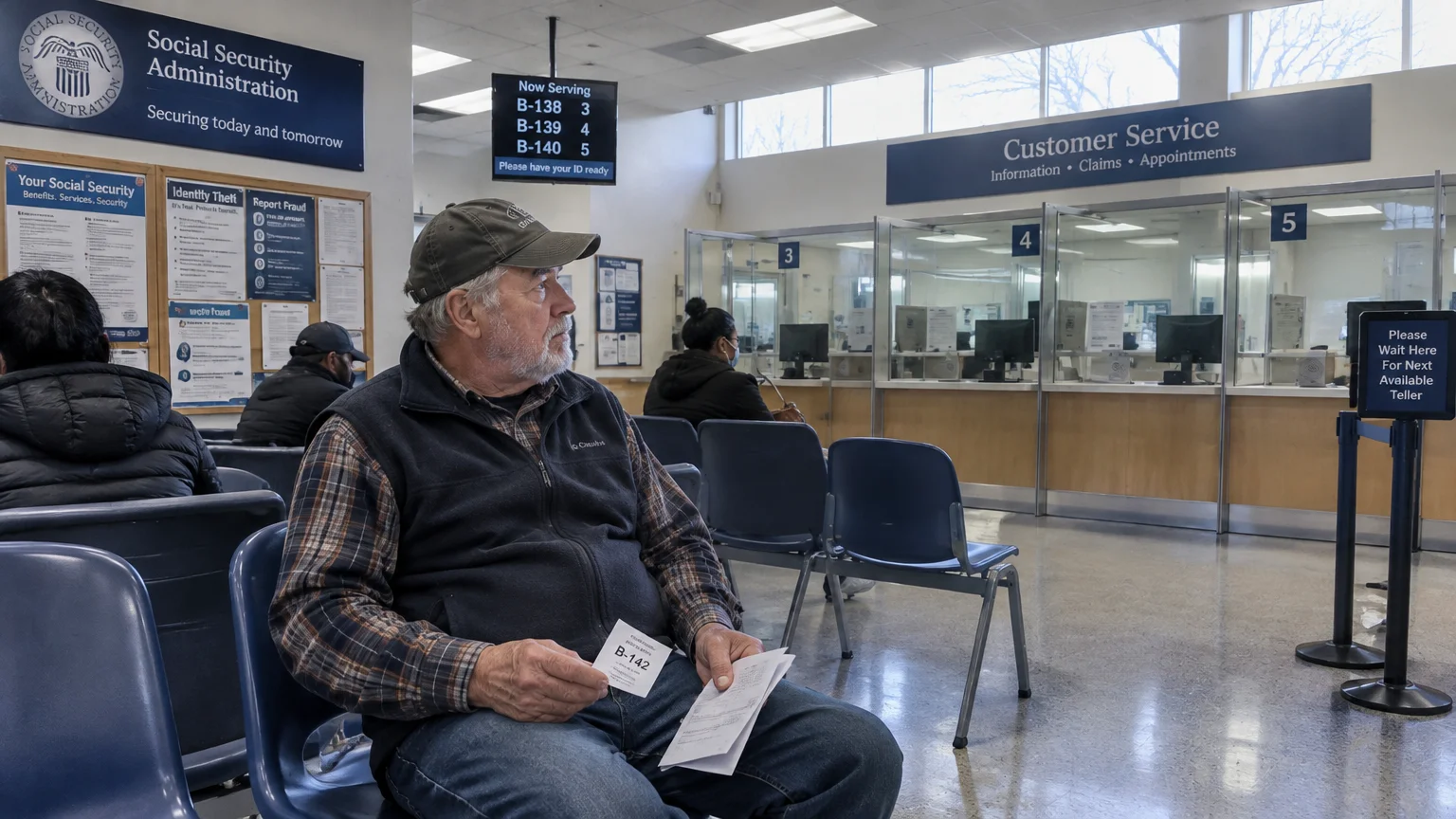
At the same time, sweeping operational restructuring has reshaped the agency tasked with handling those beneficiary questions. By mid-2026, SSA had reduced its workforce by more than 8,000 employees—representing 13 percent to 14 percent of total staff—amid restructuring tied to the Department of Government Efficiency (DOGE) push.
Commissioner Bisignano defends the leaner headcount by pointing to modernization and anti-fraud initiatives. He argues that tightening payment integrity and streamlining records represent essential stewardship before Congress ever asks taxpayers for new revenue.
However, independent economists and Bipartisan Policy Center analysts warn against treating administrative savings as a solvency cure-all. Even aggressive fraud elimination cannot bridge a $29.3 trillion to $30 trillion 75-year gap.
Treating waste reduction as a substitute for tax or benefit legislation creates a dangerous political illusion for voters. When official messaging minimizes structural deficits, lawmakers face less public urgency to negotiate durable compromises before 2032.
Frequently Asked Questions About the 2032 Social Security Cliff
Does Social Security Stop Paying Benefits Completely in 2032?
No, benefits do not drop to zero when the trust fund reserves hit empty in late 2032. Ongoing payroll taxes and existing benefit income taxes will continue flowing into the Treasury every single month.
Under the 2026 Trustees Report, those ongoing revenues cover 78 percent of scheduled OASI payouts, triggering an automatic 22 percent reduction unless Congress acts. If lawmakers reallocate reserves from the solvent DI fund, combined reserves last until the third quarter of 2034, after which payouts drop to 83 percent.
Did the One Big Beautiful Bill Act Eliminate Taxes on Your Social Security Check?
No, federal income taxes on Social Security benefits remain active law in 2026 and beyond. Combined income above $25,000 for single filers or $32,000 for married couples still triggers taxation on 50 percent to 85 percent of benefits.
Instead of full repeal, OBBBA added a temporary $6,000 deduction per taxpayer age 65 and older through tax year 2028. Check your modified adjusted gross income against the $75,000 single and $150,000 joint phaseout thresholds before adjusting your withholding.
How Does the 2032 Crisis Compare to the 1983 Social Security Rescue?
In 1983, Social Security stood just months away from missing full benefit checks before Congress passed bipartisan reforms. Lawmakers gradually lifted the full retirement age to 67, accelerated payroll tax increases, and introduced federal income taxes on benefits.
Today’s structural imbalance is much larger because the baby-boom retirement wave leaves far fewer workers supporting each retiree. Closing a 4.42 percent payroll gap requires significantly larger revenue increases, benefit adjustments, or a balanced mix of both.
Can Cracking Down on Fraud Alone Fix the Trust Fund Deficit?
Independent economists and bipartisan policy analysts confirm that eliminating waste and improper payments cannot solve the insolvency timeline. While tightening eligibility verification protects taxpayer trust, improper payments represent a tiny fraction of annual $1.60 trillion outlays.
Fixing the 2032 cliff requires statutory action from Congress, not executive management tweaks. Only changes to payroll tax rates, earnings caps, retirement ages, or benefit formulas alter the long-term actuarial balance.
What You Should Monitor Before the 2032 Deadline
Over the next two legislative cycles, three concrete checkpoints will signal whether Congress intends to stabilize Social Security or drift toward automatic cuts. Tracking these dates lets you adjust your personal retirement strategy early rather than reacting under pressure.
First, watch the 2028 expiration date built into OBBBA’s $6,000 senior deduction. Allowing the deduction to sunset as scheduled restores trust fund tax inflows, whereas extending or expanding it pushes the insolvency deadline even earlier unless offset elsewhere.
Second, monitor whether Congress moves a standalone bill reallocating payroll tax shares from the Disability Insurance fund to OASI. That accounting adjustment buys roughly two extra years—shifting the cliff from late 2032 toward 2034—without solving the underlying deficit.
Third, follow annual SSA Trustees Reports and CBO updates for shifts in immigration and wage-growth assumptions. Continued reductions in net worker inflows tighten payroll tax receipts and shrink the margin for legislative delay.
While Washington debates those timelines, take three practical steps to protect your household finances today. Log into your personal SSA account each year to verify your reported earnings history, especially given recent agency staffing reductions.
Next, consult a qualified tax preparer or check Tax Policy Center guidance to confirm whether you qualify for the $6,000 deduction through 2028. Never assume your benefits are automatically tax-free without checking your combined income thresholds.
Finally, stress-test your personal retirement plan against a hypothetical 22 percent Social Security reduction if you expect to claim benefits near 2032. Building extra personal savings or delaying your claiming age gives you a durable buffer no matter which party wins the next fiscal standoff.