

Pump prices are finally sliding back under $4 a gallon just ahead of Thanksgiving. Still, filling your tank costs roughly 79 to 92 cents more per gallon than it did last November.
Daily drops across major fuel trackers show wholesale relief is reaching neighborhood stations. Knowing why prices spiked this year—and how far they could fall before Nov. 26—helps you time your holiday fill-ups.
You cannot erase a historic year of supply shocks overnight, yet smart routing can protect your travel budget. Here is what the latest federal, industry, and state data mean for your wallet.
Breaking Down the Drop—and That 92-Cent Gap
Gasoline prices are moving down quickly enough that two readings taken days apart tell noticeably different stories. Understanding that timeline prevents confusion when you compare headlines against the sign at your corner station.
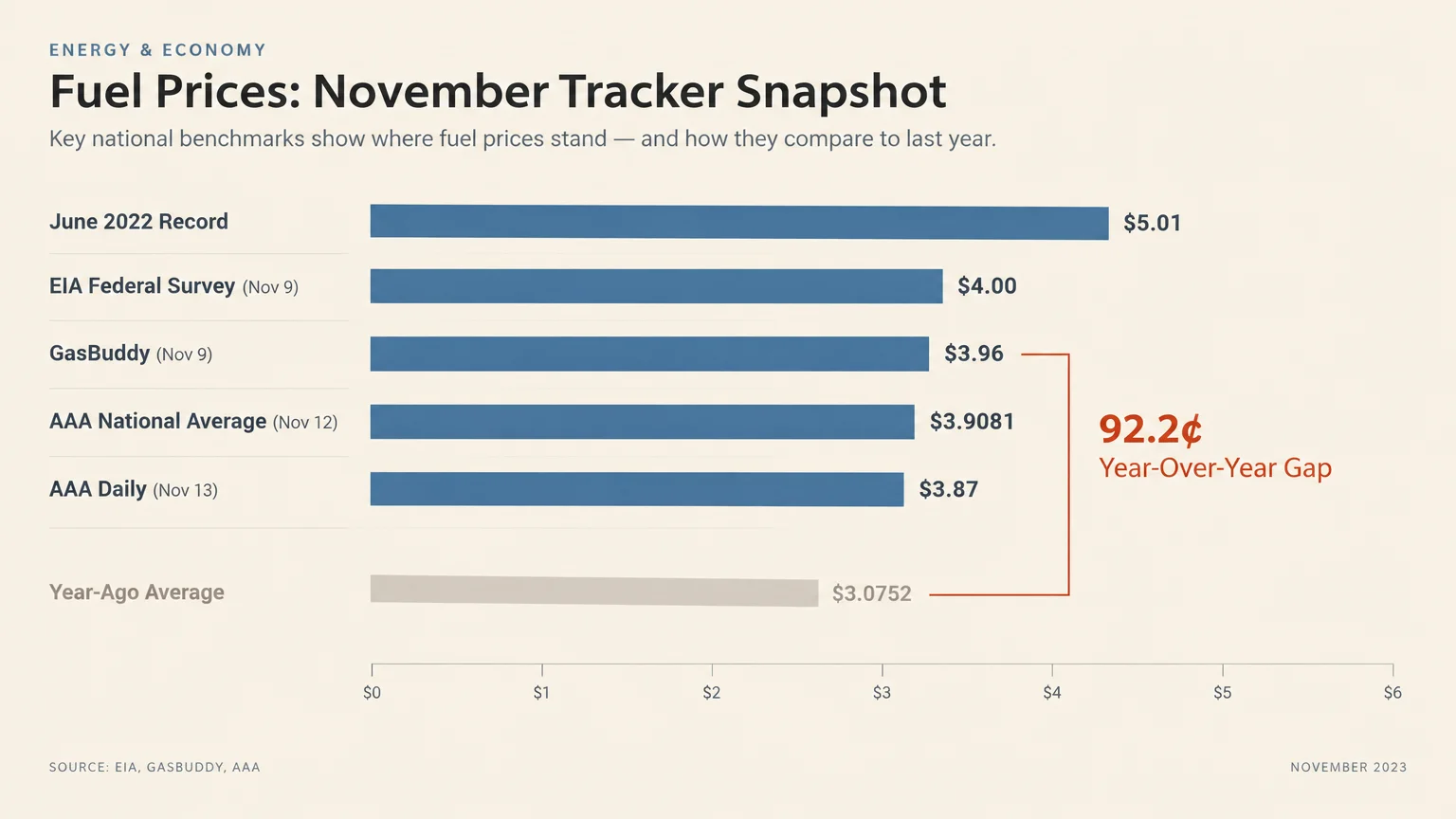
On Monday, Nov. 9, 2026, GasBuddy reported the national average fell to $3.96 per gallon. That marked the first reading under $4 since early August, reflecting a 15.9-cent weekly drop and a 39.3-cent monthly decline.
Even after that slide, the Nov. 9 average stood 92.2 cents higher than a year earlier. That snapshot explains why drivers still feel intense sticker shock despite falling retail trends.
By Thursday, Nov. 12, the AAA national gas price tracker showed regular gasoline dropping nearly 20 cents in a single week to $3.9081 per gallon. That decline moved AAA’s average below $4 for the first time since July.
AAA’s Nov. 12 figure was well below the $4.1003 average recorded a week earlier and $4.3556 a month prior. Yet it remained roughly 83 cents above the year-ago average of $3.0752 per gallon.
Continued retail discounting pushed AAA’s daily average down again on Friday, Nov. 13, to $3.87 per gallon, as reported by CBS News. That reading narrowed the annual gap to $0.79 per gallon, sitting $0.47 lower than a month earlier.
Weekly federal surveys move slightly slower than daily retail trackers, which explains the higher benchmark from Washington. For the week of Nov. 9, the U.S. Energy Information Administration placed regular retail gasoline at $4.00 per gallon.
That federal average dropped from $4.15 the week before, though it stayed 30.7% higher year over year. For broader context, it sits 20% below the nominal U.S. record of $5.01 per gallon set in June 2022.
Your immediate takeaway is simple: wait as long as safely possible before topping off your tank for holiday travel. Stations are still passing through steep wholesale declines, so waiting a few days often saves you several cents per gallon.
Diesel and Jet Fuel Keep Travel Budgets Tight
Gasoline relief does not mean the rest of the energy complex has cooled down. Heavy transport fuels remain painfully elevated, raising the indirect cost of your Thanksgiving groceries and plane tickets.
AAA put national diesel prices at $6.06 per gallon on Nov. 13. While that beats the all-time record of $6.53 set on Sept. 22, 2026, it towers over the $3.73 to $3.75 range drivers saw a year ago.
Because freight trucks burn diesel, retailers still face steep delivery surcharges on holiday food and retail goods. Those freight costs filter straight into supermarket aisles long after pump prices for regular gasoline begin falling.
Air travelers face similar pressure from commercial aviation fuel markets. Airlines for America reported that spot jet fuel averaged an all-time monthly record of $4.64 per gallon in October 2026.
High jet fuel expenses give carriers little incentive to discount last-minute Thanksgiving seats. If you still need to fly, lock in itineraries immediately rather than gambling on late airfare drops.
How 2026 Pump Prices Reached Historic Territory
Back in February 2026, regular gasoline averaged under $3 per gallon in 39 states. That calm shattered on Feb. 28, when the United States and Israel launched military strikes on Iran.
Retaliatory disruptions severely restricted oil tanker traffic through the Strait of Hormuz, a chokepoint handling roughly 20% of global seaborne crude. Domestic pump prices surged roughly $1 to $1.41 per gallon in response to the supply freeze.
Other global flashpoints deepened the squeeze on refined fuel supplies at the exact same time. Ukrainian strikes on Russian refineries and lower Chinese fuel exports removed vital diesel and gasoline barrels from international markets.
Because refineries around the world were running tight, U.S. drivers could not rely on overseas imports to blunt the shock. By early autumn, pump prices sat higher than any previous November on record.
Before 2026, the national gasoline average had never topped $4 per gallon during November, according to AAA data. Even with daily declines accelerating this week, November 2026 remains on pace to finish as the costliest November ever recorded.
Why Wholesale Crude Is Finally Retreating
Crude oil is the single biggest driver behind what you pay at the pump. When crude benchmarks fall sharply, retail gas prices usually follow downward over a two-to-three-week lag.
In October, international Brent crude averaged a punishing $124 per barrel. Early November brought an abrupt reversal as physical exports improved and war-risk premiums eased.
By Nov. 11, West Texas Intermediate crude settled at $86.53 per barrel, while Brent dropped back below $100 per barrel. Two major developments drove that sudden sell-off across global energy trading desks.
First, Persian Gulf producers restored partial export flows by restarting Saudi Arabia’s East-West Pipeline and expanding offshore ship-to-ship transfers. Those workarounds eased fears of a prolonged maritime blockade in the Strait of Hormuz.
Second, post-election signals pointing toward potential U.S.-Iran diplomacy cooled trader expectations of wider regional escalation. Lower geopolitical tension stripped speculative risk out of crude futures.
Domestic Inventories and Demand Signals
Weekly supply figures from the U.S. Energy Information Administration confirm that domestic fuel cushions are gradually rebuilding. Data for the week ending Nov. 6, released on Nov. 12, showed healthier stockpiles across both crude and finished gasoline.
U.S. gasoline demand dipped to 8.76 million barrels per day, down from 8.80 million barrels the prior week. Lower everyday driving gives wholesalers less pricing power heading into the holiday rush.
At the same time, total domestic gasoline inventories climbed to 210.8 million barrels. Commercial crude oil inventories also rose by 4.7 million barrels, reaching 414.4 million barrels.
Keep in mind that U.S. crude stockpiles still sit 4% below their five-year average. Supply buffers remain thin enough that any sudden refinery outage or renewed shipping clash could pause the downward trend at your local station.
Watch wholesale momentum rather than one-day station swings. As long as crude stays below $90 per barrel and inventories build, stations have room to shave additional cents off their street prices.
Political Fallout, Emergency Releases, and Tax Relief
Pump prices did not just strain household checking accounts; they reshaped the 2026 political landscape. Record energy costs dominated voter frustration right up through Election Day on Nov. 3.
Gasoline averaged roughly $4.15 per gallon on Election Day, marking the highest pump price for any U.S. election on record. Voters responded by handing Democrats control of both the U.S. Senate and the House of Representatives.
One day later, on Nov. 4, President Donald Trump addressed the political cost of elevated fuel during an interview with Fox News. He noted that voters agreed with his Iran policy “but they really probably weren’t willing” to accept higher short-term gasoline prices.
President Trump subsequently signaled he is unlikely to order extensive new strikes on Iran while diplomatic talks continue. For motorists, any pause in military escalation reduces the immediate threat of another $1-per-gallon spike.
Strategic Petroleum Reserve Hits a 44-Year Low
Before November’s market pullback, Washington and allied capitals leaned heavily on emergency oil stockpiles to prevent fuel shortages. Those coordinated releases cushioned commercial markets at a steep long-term cost.
The United States committed 172 million barrels via exchange agreements as part of a broader 400-million-barrel release coordinated by the International Energy Agency. On Oct. 2, G7 nations added another 100 million barrels of crude and diesel to global supply.
Those historic drawdowns pushed the U.S. Strategic Petroleum Reserve down to 279.5 million barrels as of Nov. 6, 2026. That stands as the reserve’s lowest level since October 1982, leaving well over half of its 714-million-barrel authorized capacity empty.
A depleted emergency reserve leaves federal policymakers with far less firepower if another Middle East disruption hits this winter. Future supply shocks would pass through to retail fuel pumps much faster without a deep federal buffer.
EPA Waivers and State Tax Holidays
Regulators also tweaked fuel-blending rules late this summer to squeeze extra supply out of existing refineries. On Aug. 20, 2026, the Environmental Protection Agency invoked Clean Air Act Section 211(c)(4)(C) due to Middle East disruptions.
Under that emergency waiver, the EPA extended nationwide summertime E15 ethanol blending permissions. It also moved up the transition to cheaper winter-blend gasoline to Sept. 1, two weeks ahead of the standard Sept. 16 federal deadline.
Winter-blend fuel contains cheaper butane components and costs refiners less to produce than tightly regulated summer blends. Accelerating that switch helped cap retail prices during early autumn.
Federal motor fuel excise taxes remained unchanged at 18.4 cents per gallon for gasoline and 24.4 cents for diesel, rates untouched since October 1993. However, President Trump deferred the federal diesel excise tax and allowed highway use of tax-free dyed diesel through year-end.
State tax burdens vary dramatically depending on where you fill up. State gasoline taxes and fees averaged 33.3 to 33.5 cents per gallon in early 2026, ranging from roughly 9.0 cents in Alaska to between 70.9 and 73.6 cents in California.
Seven states—Georgia, Illinois, Indiana, Kentucky, North Carolina, Ohio, and Utah—enacted gas tax holidays or delayed planned tax hikes during 2026 to help commuters. Note that Georgia’s tax suspension expired after Nov. 5, meaning pump prices there no longer enjoy that temporary state discount.
Economic Stakes: Inflation, State Spreads, and Holiday Costs
Energy prices ripple through nearly every corner of the U.S. economy, complicating inflation trends just as households budget for holiday gifts and travel. Fresh federal inflation numbers released on Nov. 10 highlight that lingering pressure.
According to the Bureau of Labor Statistics, the overall Consumer Price Index rose 0.4% in October 2026 on a seasonally adjusted basis. That monthly pace cooled from 0.6% in September, offering modest relief across broader consumer categories.
On a seasonally adjusted basis, the October gasoline index still climbed 1.0%, following a massive 9.1% jump in September. Looking at unadjusted street prices, however, gasoline actually dipped 0.7% during October as late-month declines began.
Reading the year-over-year inflation report requires paying close attention to a federal reporting quirk. Because an appropriations lapse prevented the Bureau of Labor Statistics from collecting October 2025 survey data, the agency omitted most official 12-month CPI rates.
Even with those omissions, the summary table listed all-types gasoline up 37.4% over the past year, worsening from a 34.2% annual gap in September. For families managing fixed monthly budgets, fuel costs remain the sharpest source of inflation pain.
Where You Pay the Most—and Least—by State
National averages hide massive regional gaps that can make or break a multi-state road trip. Where you pull off the highway matters just as much as when you buy fuel.
AAA data from Nov. 12 revealed a $2.45-per-gallon spread between the cheapest and costliest states in the country. West Coast and island drivers still face stubbornly high regional refinery costs and steep state fuel taxes.
Hawaii and California tied for the highest state average on Nov. 12 at $5.63 per gallon. Nevada followed at $4.96, Washington at $4.90, and Oregon at $4.53.
Southern and Midwestern motorists are seeing much faster relief thanks to proximity to Gulf Coast refining hubs and lower state taxes. North Carolina led the nation with the lowest average at $3.18 per gallon on Nov. 12.
Texas followed closely at $3.38 per gallon, with Georgia at $3.40, South Carolina at $3.45, and Indiana at $3.47. Those regional gaps explain why some drivers already see familiar low-three-dollar signs while coastal residents still pay well over $5.
GasBuddy reported on Nov. 11 that 32 states already averaged under $4 per gallon. Its analysts project that up to 44 states could fall below that $4 mark by Thanksgiving Day.
Use state borders strategically on interstate drives. If your holiday route crosses from California into Arizona or Nevada, or between higher-tax states and North Carolina or Indiana, plan your fill-ups across the lower-tax border.
Check station pricing apps before exiting the interstate. Stations situated right off major highway ramps frequently charge more per gallon than neighborhood stations deeper into town.
What to Expect Through Thanksgiving and Into 2027
More relief is coming between now and Nov. 26, though you should not expect prices to return to 2025 levels anytime soon. Both holiday travel forecasts and federal energy projections point toward a gradual glide path downward.
On Nov. 11, GasBuddy petroleum analyst Patrick De Haan projected that the national gas average will ease to between $3.59 and $3.69 per gallon on Thanksgiving Day. That updated outlook beat his earlier $3.75 forecast as wholesale markets softened faster than anticipated.
Diesel drivers will see far slower progress over the next two weeks. De Haan projected diesel will settle only slightly lower to between $5.85 and $5.95 per gallon by Nov. 26.
Even if regular gasoline hits the $3.59 bottom of that range, Thanksgiving 2026 will rival or break the all-time holiday record. AAA recorded the previous Thanksgiving peak at $3.58 per gallon in 2022, while GasBuddy’s records back to 2000 list $3.56.
Meanwhile, millions of Americans are still preparing to hit the road and pack airport terminals. AAA will release its official 2026 Thanksgiving Travel Forecast on Monday, Nov. 16.
Last year’s 2025 forecast projected a record 81.8 million travelers, including 73.3 million motorists driving to their destinations. High fuel costs could trim marginal road trips this year, yet heavy highway congestion remains a certainty.
In the skies, Airlines for America expects nearly 29 million passengers—roughly 2.7 million flyers daily—between Nov. 20 and Nov. 30. Peak airport crowding is forecast for Sunday, Nov. 29, and Monday, Nov. 30.
Longer-Term Price Risks and Congressional Oversight
Looking past the holiday weekend, federal energy economists do not anticipate a quick return to $3 gas across 2027. Tight global refining capacity continues to keep a high floor under retail fuel costs.
In its Nov. 10 Short-Term Energy Outlook, the U.S. Energy Information Administration projected retail gasoline will average $3.89 per gallon across all of 2026. That compares sharply with the $3.10 full-year average motorists paid in 2025.
For 2027, the agency expects retail gasoline to average $3.73 per gallon. Notably, federal analysts raised that 2027 forecast from $3.56 in October because refined-fuel supplies remain structurally tight worldwide.
Several key policy decisions in Washington will shape energy markets over the next three months. First, traders will scrutinize diplomatic talks with Iran; any breakdown could quickly push crude back above $100 per barrel.
Second, the incoming Democratic-led Congress will face immediate debates over how and when to refill the Strategic Petroleum Reserve from its 44-year low. Buying millions of barrels back into federal caverns adds incremental demand to crude markets.
Third, watch the year-end expiration of President Trump’s federal diesel excise tax deferral and dyed-diesel waiver. Unless Congress or the White House extends those measures, commercial trucking taxes snap back into place on Jan. 1.
Frequently Asked Questions About 2026 Thanksgiving Gas Prices
Why did headlines say gas is 92 cents higher than last year if AAA shows a smaller gap?
GasBuddy reported a 92.2-cent annual gap on Monday, Nov. 9, when the national average sat at $3.96 per gallon. Subsequent daily price drops pushed AAA’s average to $3.90 on Nov. 12 and $3.87 on Nov. 13, shrinking the year-over-year gap to roughly 79 to 83 cents.
Tracking agencies also collect station data on slightly different schedules. Either way, you are paying substantially more than last November’s roughly $3.08 average.
Will gas prices keep falling before Thanksgiving Day?
Yes, current wholesale trends point to additional declines before Nov. 26. GasBuddy analyst Patrick De Haan projects the national average will ease to $3.59 to $3.69 per gallon by Thanksgiving Day.
Waiting to refuel until a day or two before your departure should capture lower street prices. Avoid filling an empty tank a full week early unless your local station runs an unusually steep discount.
Why is diesel still over $6 a gallon while regular gas is dropping?
Global diesel supplies tightened severely after Ukrainian strikes damaged Russian refineries and China reduced fuel exports. Because heating oil and heavy freight rely on the same distillate pool, diesel prices stay stubbornly high during autumn.
AAA’s $6.06-per-gallon reading on Nov. 13 sits far below September’s $6.53 record, yet relief remains gradual. Forecasts put diesel only slightly lower at $5.85 to $5.95 per gallon by Thanksgiving.
Can you save money by waiting to fill up or switching to E15?
If your vehicle is a 2001 or newer car, light truck, or SUV approved for E15, choosing that 15% ethanol blend can save several cents per gallon under the EPA’s extended waiver. Always check your owner’s manual or fuel cap first, because older engines and motorcycles cannot safely use E15.
You can also trim fuel burn on highway trips by checking tire inflation and removing unused rooftop cargo carriers. Simple maintenance habits prevent wasted mileage when per-gallon prices stay above $3.50.
How to Monitor Prices Before Your Holiday Trip
Keep your eye on Monday’s AAA Thanksgiving Travel Forecast on Nov. 16 to gauge peak highway congestion along your corridor. Sitting in holiday gridlock burns extra fuel and erases per-gallon savings.
Check daily retail averages in your departure and destination states every 48 hours between now and Nov. 25. Because up to 44 states are projected to slip under $4 per gallon by Thanksgiving, local competition should intensify across most metro areas.
Watch daily crude oil settlements alongside news on U.S.-Iran diplomacy, since sudden swings in Brent or West Texas Intermediate quickly signal whether station discounts will accelerate or stall. Staying flexible on when and where you stop gives you the best shot at beating a record-high holiday fuel market.